


Health Officer Minute: Loss of Measles Elimination Status

Back in 2000, the U.S. earned “measles elimination status.” That means measles wasn’t spreading for a year or more. We got there by watching for cases, acting fast when they showed up, and emphasizing vaccinations, especially school-age kids. In 2000, more than 95% of school-age children had their MMR shots. That’s the magic number that stops measles from spreading and protects the whole community. Elimination didn’t mean zero cases, though. From 2000 to 2018, the U.S. had fewer than 150 cases a year and only three deaths. Most cases were in people who weren’t vaccinated, and 94% of the cases that started in the U.S. were linked to international travel.
Vaccines are a big part of public health because they stop problems before they start. The CDC says that among the roughly 117 million kids born between 1994 and 2023, routine childhood vaccines will have prevented 508 million illnesses, 32 million hospitalizations, and more than 1.1 million deaths. Vaccines work.
Sadly, vaccination rates have been declining. The CDC notes the measles vaccination rate has dropped about 3% over the past eight years. In 2019–20, 95.2% of kindergartners were fully vaccinated. That number has fallen every year since the pandemic and is now 92.4%. That’s below the 95% needed to protect a community. Measles is one of the most contagious diseases in the world. One sick person usually infects 12–18 others who have no protection, and up to 90% of people who aren’t immune and are close to a sick person will catch it.
As of November 13, the CDC has recorded 5,412 confirmed cases. That’s more than twice the total for all of 2025. Cases have been reported in 46 states and Washington, D.C., and there have been outbreaks (3 or more related cases). There have been 10 measles deaths, the most in more than 30 years. Washington has had 58 cases in 2026, compared with 12 in 2025. About 90% of those cases were in unvaccinated people, and 9% had an unknown vaccination status. In 2025, 75.3% of Washington children ages 19–35 months were up to date on MMR (at least 1 dose). That’s down from 82.5% in 2019.
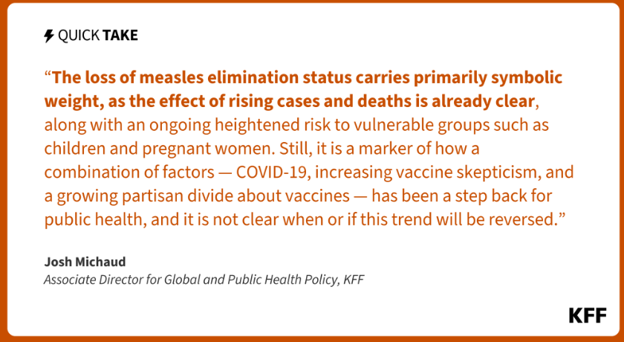
Losing our elimination status might be “symbolic,” but in public health we see it as much more. It’s a sign that the system has failed to keep our communities healthy and safe. ACHD works to do this by “…promoting health, preventing illness, and protecting the environment to help those who work, play, and live in Asotin County achieve their best health.” I’d say our community has done its part. Our 7th graders have done better than the state and keep improving. Last year, 98% were vaccinated for measles. Kindergarten rates have also gone up and are better than the state’s. (Note: kindergarten rates look lower because the second dose isn’t due until age 4–6.) ACHD works closely with our schools, and these numbers show it.
I often cite the Institute of Medicine’s definition of public health: “what we, as a society, do collectively to assure the conditions in which people can be healthy” (from the 1988 report The Future of Public Health). The key word is “collectively.” Public health can’t do this alone. We need everyone.
What can you do?
- Make sure your kids are up to date on measles shots. That means 2 doses of MMR (or MMRV). The first is given at 12–15 months and the second at 4 through 6 years. Two doses are about 97% effective and protect you for life.
- If you’re an adult, know your vaccine status. Most adults are likely protected because they were vaccinated, had a lab-confirmed past infection or immunity, or were born before 1957. Most low-risk adults born in 1957 or later need 1 dose. Higher-risk adults without proof of immunity need 2 doses. That includes healthcare workers, international travelers, college or trade-school students, and people who live with or are close to someone with a weak immune system.
- This matters even more if you’re around people at high risk, like children under 5, adults over 20, pregnant people, and people with weak immune systems. Infants are too young to finish their shots before 12–15 months, so they often end up in the hospital with serious problems.
- Traveling for the holidays? Check out https://publichealth.jhu.edu/ivac/resources/us-measles-tracker to see what the measles risk looks like where you’re headed.
Let’s have a safe, healthy holiday season and keep Asotin County from becoming a statistic.
